What Training Certificates Should Every Cleaning Employee Have?
A guide for UK cleaning business owners on which training certificates cleaning operatives should hold, which are legally required, and which are commercially important for winning contracts.
When a facilities manager asks your operatives what training certificates they hold and the answer is “we did an induction when we started,” you are not going to win that contract.
Training certificates are not just a box-ticking exercise. For cleaning businesses, they serve three distinct purposes: meeting your legal obligations as an employer, protecting your business if something goes wrong, and winning commercial work where clients require documented evidence of staff competence.
This article covers the certificates that matter, which ones apply to which types of work, and how to make sure your records are audit-ready.
Certificate quick reference
| Certificate | Who needs it | Legal basis | Minimum renewal |
|---|---|---|---|
| Cleaning induction | All new starters | Health and Safety at Work Act 1974 | Once (refresh if role changes) |
| COSHH awareness | All operatives using cleaning chemicals | COSHH Regulations 2002 | Every 2 years |
| Manual handling | All operatives | Manual Handling Regulations 1992 | Every 3 years |
| Health and safety fundamentals | All staff | Health and Safety at Work Act 1974 | Every 2 years |
| Clinical cleaning | Healthcare site operatives | NHS National Standards 2021 | Per IPC guidance |
| Biohazard response | Operatives handling bodily fluids | COSHH / general H&S legislation | Every 2 years |
| Floor maintenance | Rotary/polishing machine operators | Health and Safety at Work Act 1974 | Every 3 years |
| High-level cleaning | Operatives working above floor level | Working at Height Regulations 2005 | Every 2 years |
| Supervision and management | Site supervisors and area managers | Health and Safety at Work Act 1974 | Every 3 years |
Key Takeaways
- UK law does not specify a single cleaning certificate — it requires evidence that training covered the actual risks your staff face, under COSHH 2002, Manual Handling Regulations 1992, and the Health and Safety at Work Act 1974.
- The HSE estimates that manual handling accounts for over a third of all workplace injuries — making a manual handling certificate one of the most practically important pieces of training evidence you can hold.
- Every operative should hold four core certificates before working unsupervised: induction, COSHH awareness, manual handling, and health and safety fundamentals.
- BICSc, IOSH Working Safely, and NEBOSH are recognised by commercial clients in tender processes and strengthen your position beyond the legal baseline.
The legal baseline: what UK law requires
UK employment law does not specify a single “cleaning certificate” that all staff must hold. Instead, the legal requirement is broader: you must provide adequate training for the risks your employees face. Several pieces of legislation create specific training duties.
The Health and Safety at Work Act 1974 requires you to provide information, instruction, training, and supervision to ensure, so far as is reasonably practicable, the health, safety, and welfare of your employees.
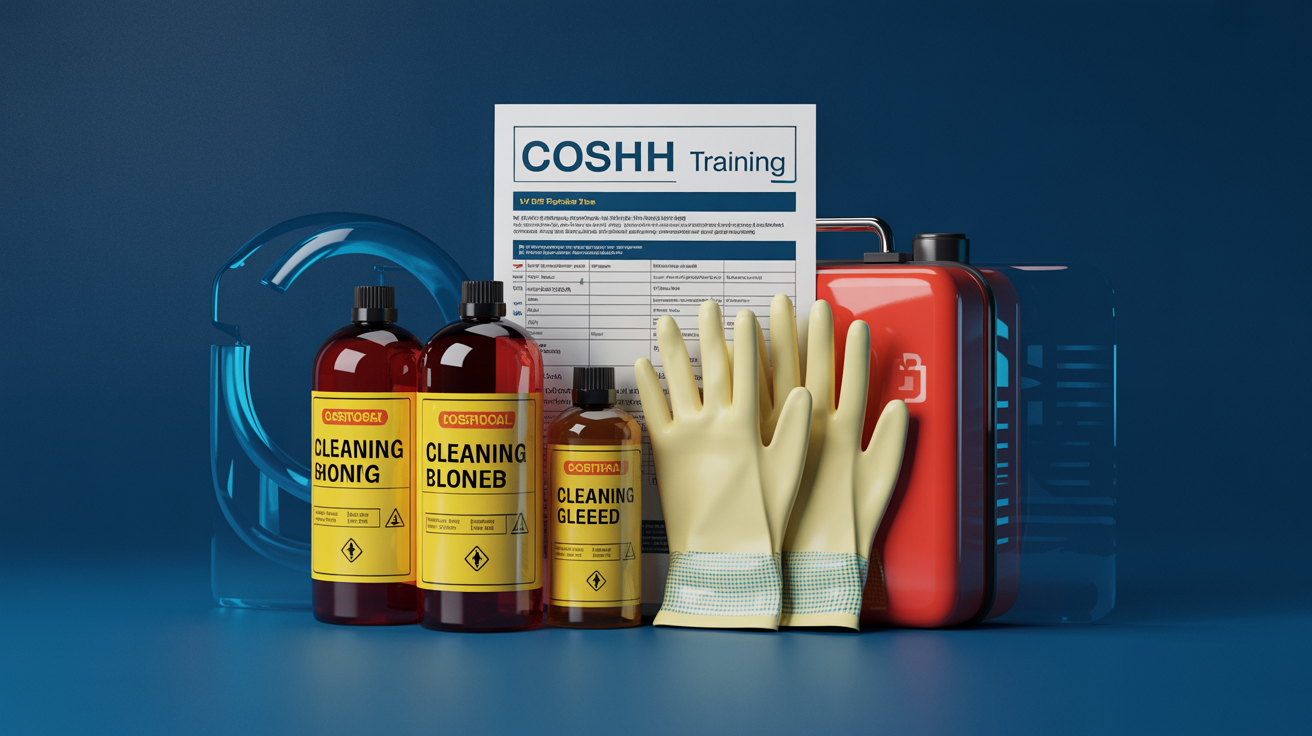
The Control of Substances Hazardous to Health Regulations 2002 (COSHH) require you to assess the risks from hazardous substances used in cleaning and ensure employees are informed and trained on those risks. For a detailed breakdown of what your COSHH training must cover, see the COSHH training requirements guide.
The Manual Handling Operations Regulations 1992 require you to provide training where manual handling cannot be avoided. For cleaning staff carrying equipment, lifting buckets, and moving furniture, this applies in most cases. The manual handling training guide for cleaners covers the precise legal requirements.
The Personal Protective Equipment at Work Regulations 2022 require you to ensure PPE is provided and that staff know when to use it, how to use it, and why.
RIDDOR 2013 is not a training requirement itself, but your staff need to know what to report and how. This is part of your H&S induction. The RIDDOR reporting guide for cleaning businesses explains the obligations in full.
None of these regulations specify a particular qualification or certificate format. What they require is documented evidence that training happened, covered the right content, and was understood by the employee. A certificate that names the individual, the course content, and the completion date provides that evidence.
Core certificates: every cleaning operative
These are the training certificates every member of your cleaning team should hold before working unsupervised on any site.
Cleaning induction certificate
An induction certificate confirms that the operative has been through a structured onboarding programme covering professional conduct, workplace expectations, and the responsibilities of the role. For new starters, this should be completed before their first solo shift. See the new starter induction checklist for a complete template covering every item to include.
COSHH awareness certificate
A COSHH awareness certificate confirms the operative understands the chemicals they use, the risks those chemicals present, how to read a product label and safety data sheet, and what to do if there is a chemical incident.
This is one of the most defensible certificates you can hold if a health and safety incident involves chemical exposure. Without it, your position in any investigation or insurance claim is considerably weaker.
Manual handling certificate
A manual handling certificate confirms the operative has received training in correct lifting and carrying technique. Given that cleaning work involves carrying equipment, moving furniture, and handling full mop buckets, manual handling injuries are a real risk.
The HSE reports that manual handling accounts for over a third of all workplace injuries in the UK. A dated certificate showing training was completed is essential documentation.
Health and safety fundamentals certificate
A broader H&S certificate covering slips and trips, working at height (including step stools), fire safety, emergency procedures, accident reporting, and PPE requirements. This gives you documented coverage of the general H&S obligations under the 1974 Act.
Role-specific certificates
Beyond the core set, certain roles and site types require additional training certificates.
Clinical cleaning certificate
Required for any operative working in a healthcare setting: GP surgeries, dental practices, care homes, or NHS facilities. Clinical cleaning has specific infection prevention and control (IPC) requirements, colour-coding protocols, and documentation standards that go beyond general cleaning.
NHS and healthcare clients will typically ask for evidence of this training before granting site access. The NHS National Standards of Healthcare Cleanliness 2021 sets out the relevant requirements.
Biohazard response certificate
Required for any operative who may be called to clean up blood, vomit, or other bodily fluids. This covers Category B biohazard risk, PPE requirements, spill kit use, and decontamination procedure. For more on what specialist cleaning training covers, see the specialist cleaning training guide.
Floor maintenance certificate
Required for operatives using rotary floor machines, single-disc machines, or operating strip and seal procedures. Incorrect use of this equipment is a common cause of floor damage claims and slip incidents.
High-level cleaning certificate
Required for any operative cleaning above floor level using step stools or small platforms. This connects to the Working at Height Regulations 2005. The certificate should cover risk assessment for high-level work and when to refer a task to a specialist contractor.
Supervision and team management certificate
Required for anyone stepping into a supervisory role: site supervisors, team leaders, or area managers. The certificate should cover quality control, performance management, scheduling, and communication with clients and management.
Certificates that strengthen your commercial position
Beyond the legally necessary training, there are certificates that improve your position when tendering for commercial contracts.
BICSc accreditation
The British Institute of Cleaning Science (BICSc) offers a range of accredited qualifications recognised by facilities managers and contract cleaning clients. BICSc training covers colour-coding, cleaning methods, and specific skills such as hand spray technique, mopping, and vacuum cleaning. It carries weight in formal tender responses.
IOSH Working Safely
The IOSH Working Safely certificate is a one-day course from the Institution of Occupational Safety and Health covering general health and safety principles. It is not cleaning-specific but is widely recognised by commercial clients and adds credibility to your team’s training record.
NEBOSH certificate
The NEBOSH General Certificate is a more substantial qualification, usually suitable for supervisors, managers, and business owners rather than frontline operatives. If you are tendering for large public sector contracts, holding a NEBOSH certificate yourself is often noted positively.
What format should training certificates take?
For client audits and PQQ submissions, your training certificates need to contain specific information.
A compliant training certificate should include:
- The name of the staff member
- The name and logo of your company (not just the training provider’s)
- The course title and a content summary
- The date of completion
- A certificate reference number or unique identifier
Generic training provider certificates — where the training provider’s name is larger than your company’s — are not the most defensible documents in an audit context. Branded certificates issued under your company name carry more weight. This is the core argument for white-label training platforms.
Keeping records audit-ready
Holding certificates is not enough if you cannot produce them quickly when a client asks. For the full picture of what happens during a client audit and what records auditors check, see how to prepare for a client compliance audit.
A training record system should let you:
- See which staff have completed which training, at a glance
- Filter by site or contract (useful if a client asks about their specific team)
- Identify staff whose training is approaching an expiry date
- Export or print records for PQQ submissions
How often should training be renewed?
There is no single regulatory answer. General guidance is:
- H&S induction: once, at the start of employment (refreshed if the job changes significantly)
- COSHH: every two years as a minimum, or when new products are introduced
- Manual handling: every three years as a minimum
- Fire safety awareness: annually
- Clinical and specialist cleaning: aligned with the relevant IPC or sector guidance
In practice, many cleaning businesses align all renewals to a two-year cycle for simplicity.
A practical approach for small teams
If you are running a cleaning business with fewer than 20 staff:
- All staff complete core training (induction, COSHH, manual handling, H&S) before their first unsupervised shift.
- Staff assigned to specialist contracts (clinical, biohazard, floor maintenance) complete the relevant additional training before working on those sites.
- Supervisors complete a leadership and supervision course.
- Training records are maintained in a system that lets you pull them up quickly.
This covers your legal obligations, protects you in incidents, and gives you a defensible answer when clients ask about staff training.
CleanOS Training covers all seven training areas in this article: induction, health and safety, core cleaning skills, residential, commercial, specialist cleaning, and supervision. All courses issue branded certificates automatically and log completions to a single dashboard. Book a free demo to see what your team’s training programme could look like.
Ready to get your team trained?
Set up compliant, branded training for your cleaning staff in 48 hours. No trainer needed.
Book a Free Demo