RIDDOR Reporting for Cleaning Businesses: What You Must Record
RIDDOR applies to every cleaning business with employees. Here is what it requires, which incidents must be reported, how to report them, and what records you need to keep.
RIDDOR (Reporting of Injuries, Diseases and Dangerous Occurrences Regulations 2013) is one of the most commonly misunderstood pieces of health and safety legislation for small businesses. Many cleaning business owners know the name but are unclear on exactly what it requires them to do, which incidents are notifiable, and what happens if they fail to report.
This article covers the RIDDOR requirements that apply specifically to cleaning businesses, with clear guidance on what you must record, what you must report, and how to do both correctly.
Key Takeaways
- RIDDOR 2013 applies to all cleaning businesses regardless of size — if you have one employee and they suffer a reportable injury, you must report it to the HSE.
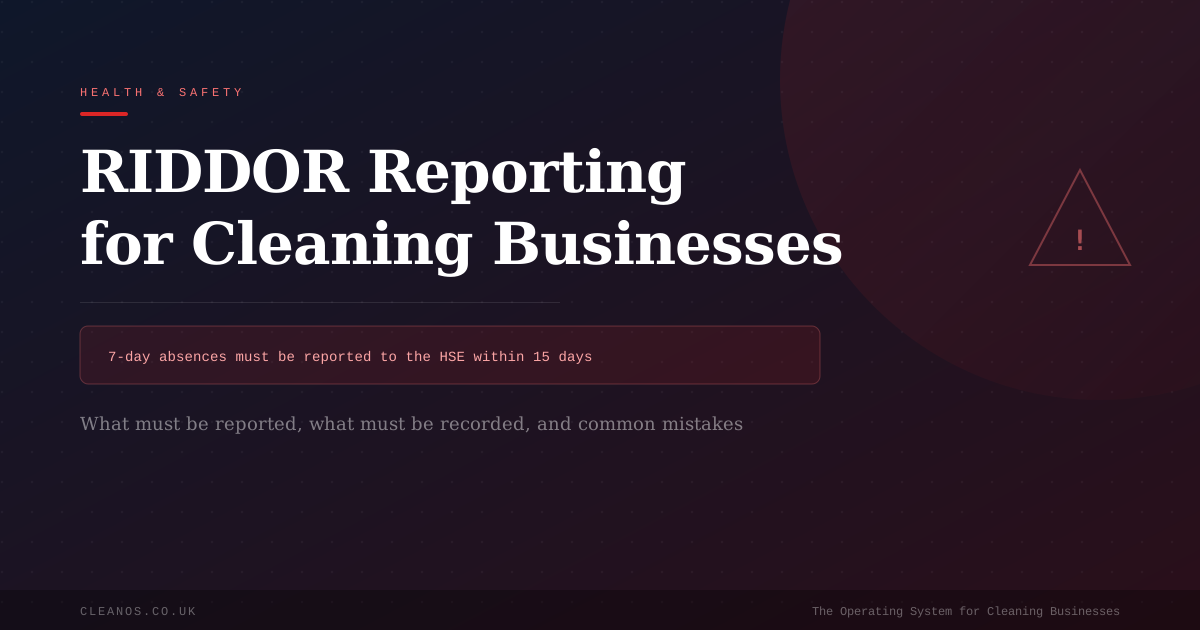
- Over-7-day incapacitations (calendar days, not just working days) must be reported within 15 days — this is the most commonly missed RIDDOR obligation in the cleaning sector.
- You must also keep internal records of over-3-day absences even though these do not need to be reported to the HSE.
- If an HSE investigation finds that adequate training was not provided before an incident, the absence of training records is treated as an aggravating factor — not a mitigating one.
What RIDDOR is and why it exists
RIDDOR requires employers, the self-employed, and people in control of premises to report serious workplace accidents, occupational diseases, and dangerous occurrences to the Health and Safety Executive (HSE).
The reporting system allows the HSE to identify trends in workplace accidents and near misses, target enforcement activity, and improve guidance for specific industries. It is also the mechanism by which fatal and serious accidents are investigated.
RIDDOR applies to all cleaning businesses that employ staff or use self-employed workers. There is no minimum employee count. If you have one employee and they suffer a reportable injury, you must report it.
What you must report
RIDDOR covers several categories of reportable event. The ones most relevant to cleaning businesses are:
| Incident type | Report to HSE? | Deadline | Internal record? |
|---|---|---|---|
| Worker death | Yes (phone + online) | Phone immediately; online within 10 days | Yes |
| Specified injury (fracture, amputation, chemical burn etc.) | Yes (online) | Within 10 days | Yes |
| Over-7-day incapacitation | Yes (online) | Within 15 days | Yes |
| Over-3-day incapacitation | No | Not applicable | Yes — mandatory |
| Occupational disease (confirmed diagnosis) | Yes (online) | When diagnosis received | Yes |
| Dangerous occurrence (no injury but serious potential) | Yes (online) | Within 10 days | Yes |
| Non-fatal public injury (taken to hospital) | Yes (online) | Within 10 days | Yes |
| Minor injury (first aid only, no time off) | No | Not applicable | Recommended |
Deaths
If a worker dies as a result of a workplace accident, you must report it immediately by phone to the HSE RIDDOR contact line (0345 300 9923), then submit a written report online within 10 days.
If a member of the public dies as a result of an accident at a workplace you manage or control, this must also be reported.
Specified injuries
Specified injuries are defined in Schedule 1 of RIDDOR 2013. For cleaning operatives, the most likely specified injuries are:
- Fractures (other than to a finger, thumb, or toe)
- Amputations
- Any injury resulting in loss of sight or reduction of sight
- Crush injuries to the head or torso causing internal organ damage
- Serious burns covering more than 10% of the body, or burns to the face, hands, feet, brain, lungs, or digestive system
- Any injury resulting in loss of consciousness caused by head trauma or asphyxia
- Any other injury arising from working in an enclosed space that leads to hypothermia or heat-induced illness
These must be reported online within 10 days of the incident.
For a cleaning business, slips on wet floors, falls from stepladders, and chemical burns are the accident types most likely to result in specified injuries.
Over-7-day incapacitation
If a worker is unable to carry out their normal duties for more than 7 consecutive days (not counting the day of the accident), this must be reported within 15 days. The 7 days include weekends and rest days, not just working days.
This is the category that catches many small cleaning businesses out. A member of staff slips on a wet floor during a clean, hurts their back, and is off work for 10 days. That incident is reportable under RIDDOR. An inadequate manual handling training record alongside that incident will significantly worsen your position in any investigation.
Occupational diseases
If a worker develops a confirmed occupational disease and the nature of their work involves the activities associated with it, this is reportable. For cleaning businesses, the relevant diseases include:
- Occupational contact dermatitis (caused by skin exposure to cleaning chemicals)
- Occupational asthma (caused by inhalation of cleaning product vapours or dusts, a direct COSHH training matter)
- Hand-arm vibration syndrome (from use of vibrating floor machines over extended periods)
- Tendonitis or tenosynovitis in the hand or forearm caused by repetitive work
These must be reported when a diagnosis is received from a doctor, and only if the worker has been doing the work associated with the disease.
Dangerous occurrences
Dangerous occurrences are defined events that did not result in injury but had the potential to do so. For cleaning businesses, the most relevant are:
- Unintended collapse of scaffolding or work equipment used for high-level cleaning
- Electrical incidents causing power cuts or equipment failure
- Incidents involving biohazardous materials that exposed workers or the public to risk
Most cleaning businesses will not encounter dangerous occurrences frequently, but they must be reported when they do.
Non-fatal accidents to members of the public
If a member of the public is injured as a result of an accident at a workplace you manage or control, and they are taken to hospital, this must be reported.
If a visitor to a client site slips on a wet floor your operative has just mopped and is taken to A&E, that is a reportable RIDDOR incident.
What does NOT need to be reported under RIDDOR
RIDDOR does not apply to:
- Injuries that do not result in time off work or a specified injury
- Road traffic accidents, unless the vehicle was being used as part of a work activity at the time
- Self-inflicted injuries
- Injuries to members of the public that do not require hospital treatment
RIDDOR is specifically about serious workplace injuries and dangerous occurrences. Minor incidents that do not meet the thresholds do not need to be reported to the HSE. However, you should still record them internally.
How to report a RIDDOR incident
All RIDDOR reports (except fatalities) must be submitted online via the HSE RIDDOR reporting portal. Fatal accidents must also be reported by phone immediately.
When completing an online report, you will need:
- Name and address of the employer
- Name, occupation, and details of the injured person
- Date, time, and location of the incident
- Description of what happened
- Nature of the injury (or dangerous occurrence type)
- Details of any first aid provided
Keep a copy of every RIDDOR report you submit. The reference number issued by the HSE should be stored alongside your internal incident records.
Time limits matter. Specified injuries must be reported within 10 days. Over-7-day incapacitations must be reported within 15 days. Missing these deadlines is a breach of the regulations.
What you must record (but not necessarily report)
RIDDOR requires employers to maintain a record of all reportable incidents, even those that have already been reported to the HSE. You must also record accidents that do not meet the RIDDOR reporting threshold but do result in work absence or injury.
Specifically, you must record:
- All reported incidents (with HSE reference numbers)
- Over-3-day incapacitations (7 or more consecutive days off must also be reported to HSE; 3 to 7 days must be recorded internally only)
- Any incident that results in a worker receiving first aid treatment, even if they return to work the same day
The record must include: date of accident, name of the person injured, their occupation, nature of the injury, location, and a brief description of the circumstances.
Many businesses use an accident book alongside digital records. If you use a physical accident book, it must comply with GDPR in terms of how entries are stored and who can access them.
RIDDOR and your duty to train staff
RIDDOR has an implication beyond the reporting requirements. If an incident is investigated by the HSE and it emerges that the worker had not received training appropriate to the risk involved, the absence of training will be treated as an aggravating factor.
An operative who slips on a wet floor and suffers a specified injury is a RIDDOR reportable incident. If the investigation reveals the operative had not received manual handling or slip hazard training, and your business has no record that training was provided, the HSE will take a much dimmer view than if you can produce a dated training certificate.
This is the direct link between RIDDOR, training records, and your compliance position: the training certificates you hold today are the evidence you may need in an HSE investigation tomorrow.
For a full picture of what records a client compliance audit will check, including how RIDDOR records fit into the wider documentation picture, see that guide.
Common RIDDOR mistakes cleaning businesses make
Failing to report over-7-day absences. Many cleaning business owners know about specified injuries but are unaware that any absence of more than 7 consecutive days following a workplace accident is reportable. This is the most common RIDDOR non-compliance issue in the cleaning sector.
Missing the deadline. The 10-day and 15-day windows run from the date of the incident, not from when the extent of injury became clear. Start the clock from day one.
Not keeping internal records for over-3-day absences. Even if the absence does not reach the RIDDOR reporting threshold (7 days), you must record it. An HSE inspection that finds a pattern of unrecorded workplace accidents is a significant enforcement risk.
Not reporting public injuries. If a member of the public is injured and taken to hospital as a result of an incident at a site you are responsible for, that is reportable. Cleaning businesses sometimes assume RIDDOR only covers their own employees.
No incident procedure in place. RIDDOR compliance requires that there is a process for identifying, recording, and reporting incidents. If no one knows who is responsible for making the RIDDOR report, it may not get made. The procedure needs to be written down and all supervisors need to know it.
Building RIDDOR compliance into your operations
Practical steps for a cleaning business:
- Train every supervisor and manager on what RIDDOR covers and what their responsibilities are when an incident occurs. The Health, Safety and Compliance course covers RIDDOR alongside all other H&S obligations.
- Maintain an accident book (physical or digital) that records all workplace incidents, including those that do not meet the RIDDOR reporting threshold.
- Create a clear procedure: who is responsible for RIDDOR reports, where the HSE reporting portal details are kept, and what information needs to be gathered immediately after an incident.
- Store all RIDDOR report confirmations (with HSE reference numbers) alongside your other compliance documentation.
- Review your incident records periodically to identify patterns: recurring injury types, particular sites, or specific tasks generating incidents.
RIDDOR compliance is not complex, but it requires a process. The businesses that get it wrong are usually the ones that treat it as something to address after an incident rather than a procedure that needs to exist in advance.
CleanOS Training covers RIDDOR reporting, accident procedures, and all core health and safety requirements in the Health, Safety and Compliance course. Certificate issued on completion, training record stored automatically. Book a free demo to see how CleanOS Training works for your business.
Ready to get your team trained?
Set up compliant, branded training for your cleaning staff in 48 hours. No trainer needed.
Book a Free Demo