COSHH Training Requirements for Cleaning Businesses in the UK (2026 Guide)
Everything UK cleaning business owners need to know about COSHH training requirements in 2026, including the 8-step assessment process, who needs training, record-keeping, and the consequences of non-compliance.
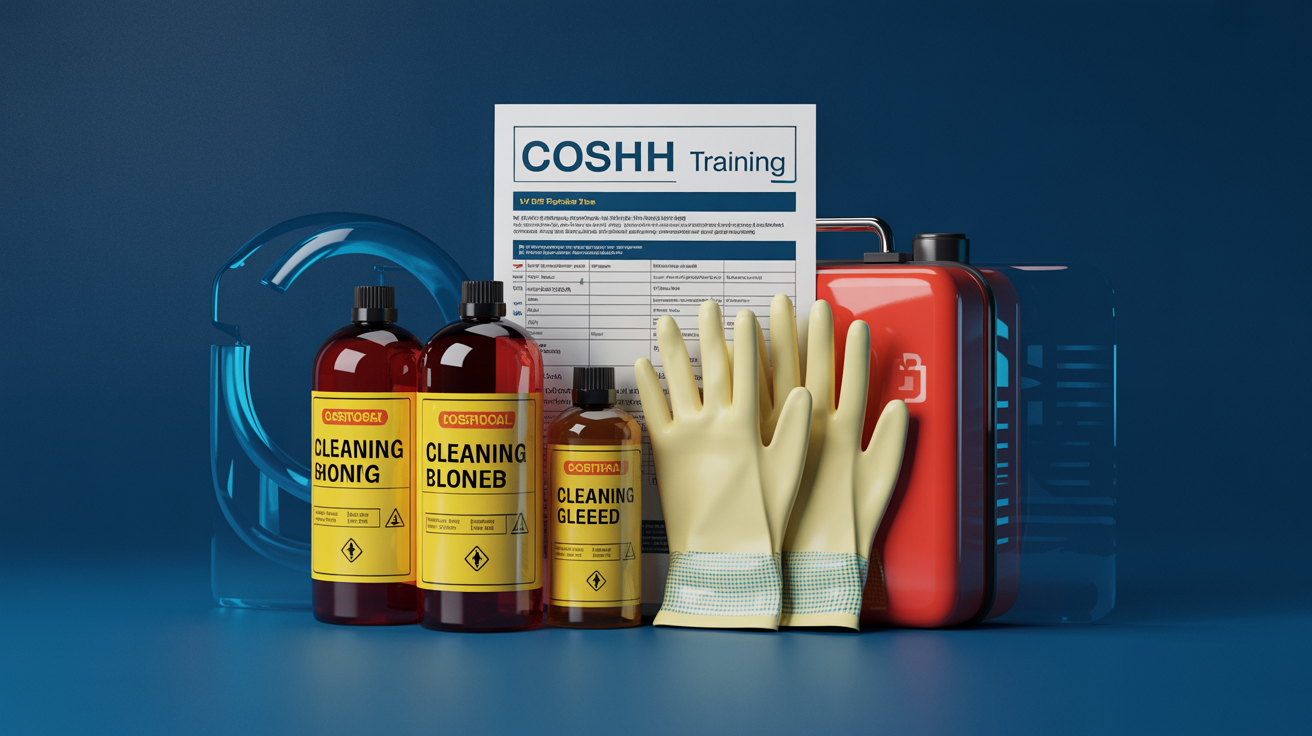
If your cleaners handle chemicals, COSHH training is not optional. The Control of Substances Hazardous to Health Regulations 2002 place a legal duty on you as an employer to assess the risk from hazardous substances and ensure your staff are trained to work with them safely. In the cleaning industry, where chemicals are handled every single day, getting this wrong puts your staff at risk and your business at serious legal exposure.
This guide covers what COSHH training must include for cleaning businesses, who needs it, how often it must be refreshed, and how to build a training programme that holds up to HSE scrutiny.
What COSHH Stands For and What the Law Requires
COSHH stands for Control of Substances Hazardous to Health. The legal framework is the Control of Substances Hazardous to Health Regulations 2002 (SI 2002/2677), which implement requirements under the Health and Safety at Work etc. Act 1974.
Under Regulation 12 of COSHH 2002, employers must provide employees with suitable and sufficient information, instruction, and training on:
- The nature of the substances they work with and the risks they present
- The precautions they must take, including the correct use of PPE
- What to do in an emergency involving those substances
- The results of any health surveillance or monitoring carried out under the regulations
“Suitable and sufficient” is a legal standard. It does not mean a one-off verbal briefing. The HSE expects training to be documented, relevant to the specific substances and tasks involved, and repeated whenever there is a change in substances, processes, or risk profile.
The Regulations apply to any substance that is toxic, harmful, corrosive, irritant, sensitising, or a biological agent. In a cleaning context, this covers most of the products your staff use every day.
Why Cleaning Businesses Are Particularly High-Risk Under COSHH
The cleaning industry sits in a high-risk category for chemical exposure for several reasons.
Frequency and volume of use. Cleaners use hazardous chemicals repeatedly throughout every working day, on multiple sites, often in enclosed or poorly ventilated spaces. The cumulative exposure from daily use of disinfectants, degreasers, and descalers is substantially higher than in many other industries.
Mixing risk. One of the most serious hazards in cleaning is the accidental mixing of incompatible chemicals. Bleach (sodium hypochlorite) combined with acidic descalers produces chlorine gas. This is a well-documented cause of acute injury in the cleaning sector. Staff who do not understand chemical hazard classifications may not recognise the danger.
Skin and respiratory sensitisation. Repeated dermal and inhalation exposure to cleaning agents, particularly quaternary ammonium compounds (quats), bleach, and some enzymatic cleaners, is associated with occupational asthma and contact dermatitis. Once a worker is sensitised, even low-level exposure can trigger a reaction. HSE data consistently identifies cleaning as a sector with elevated rates of occupational skin disease and work-related asthma.
Transient workforce. Many cleaning businesses have high staff turnover and frequently use new starters. Each new worker who has not been assessed and trained represents a distinct COSHH risk. The obligation to train applies from day one, not after the probation period.
Multiple sites and variable risk. A cleaning operative may work across offices, schools, healthcare facilities, and industrial sites in the same week. Each site may have a different chemical inventory, different ventilation, different risks. Generic COSHH training alone is not sufficient where site-specific risks differ materially.
Common UK Cleaning Chemicals and Their Hazard Classifications
Understanding how cleaning chemicals are classified under GHS (Globally Harmonised System) and the UK CLP Regulation (Classification, Labelling and Packaging of Substances and Mixtures) is fundamental to completing a proper COSHH assessment.
| Chemical | Common Use | Primary Hazard Classification |
|---|---|---|
| Sodium hypochlorite (bleach) | Disinfection, mould removal | Corrosive (skin/eyes), liberates chlorine gas when acidic |
| Hydrochloric / citric acid descalers | Limescale removal, toilet bowls | Corrosive, respiratory irritant |
| Quaternary ammonium compounds (quats) | Disinfection, multi-surface spray | Skin and respiratory sensitiser |
| Caustic / alkaline degreasers (NaOH-based) | Kitchen degreasing, oven cleaning | Corrosive to skin and eyes |
| Enzymatic cleaners | Biological waste, drains | Low acute hazard, potential sensitiser |
| Isopropyl alcohol (IPA) | Glass, electronics, sanitisers | Flammable, vapour inhalation risk |
| Solvent-based floor strippers | Strip wax/polish coatings | Flammable, narcotic at high concentration |
| Fragranced products / air fresheners | Odour control | VOC exposure, respiratory irritant |
The HSE EH40 publication (Workplace Exposure Limits) sets legally binding Workplace Exposure Limits (WELs) for many of these substances. For example, sodium hypochlorite vapour and chlorine gas are listed in EH40 with short-term and long-term WEL values. Your COSHH assessment must reference EH40 where relevant and confirm that exposures are adequately controlled.
Safety Data Sheets (SDS) for all products, prepared in accordance with UK REACH Regulation and the CLP Regulation, must be obtained from your supplier and kept on file.
Who Needs COSHH Training
The short answer is every person who handles, supervises the use of, or may be exposed to hazardous substances.
This includes:
- Cleaning operatives who directly use chemicals on site
- Team leaders and supervisors who direct operatives and are responsible for ensuring safe practice
- New starters, including those on trial or induction shifts, before they handle any chemical
- Agency and temporary workers placed with your business. The duty under COSHH applies to workers under your direction, not just employees on your payroll
- Contract staff working on your sites who are supervised by you
A common misconception is that COSHH training is only required for supervisors or for workers using “industrial” chemicals. The Regulations do not draw that distinction. If a worker handles a product with a hazard classification, they need COSHH training relevant to that product.
There is no minimum age exemption. Young workers (those under 18) are subject to additional requirements under the Management of Health and Safety at Work Regulations 1999 and require a specific risk assessment before starting work.
Training Frequency: Initial Training and Refreshers
Initial training must be completed before a worker handles any hazardous substance for the first time. This is a legal requirement, not a best practice recommendation. Sending a new cleaner to a site with cleaning chemicals before training is complete exposes both the worker and your business to unacceptable risk.
Refresher training is required when:
- A new chemical is introduced to the worker’s environment
- The task or process changes in a way that affects exposure
- The COSHH assessment is reviewed and updated
- There has been a near-miss, incident, or finding of poor practice
- Health surveillance indicates a problem
In addition to these trigger events, the general industry standard for routine refresher training is annually. While the Regulations do not prescribe a fixed interval, the HSE’s expectation is that training remains current and relevant. An annual cycle is widely accepted as meeting that standard. If you are tendering for contracts, particularly public sector contracts, you may be asked to confirm that your COSHH training is renewed at least annually.
The 8-Step COSHH Assessment Process
The HSE’s COSHH Essentials guidance sets out a structured approach to assessment. For cleaning businesses, this is how to apply it.
Step 1: Identify the Hazardous Substances
List every substance used in your business. Check the product label and the SDS (Section 2: Hazard Identification). Include cleaning chemicals, biocides, sanitisers, solvents, and any substances generated by cleaning processes (for example, dust or fumes from dry cleaning or polishing operations).
Step 2: Consider Who Might Be Harmed and How
Think about all routes of exposure: skin contact, inhalation, ingestion, and eye contact. Consider the frequency and duration of exposure, the quantities used, and the working environment. Consider third parties (clients, members of the public) as well as workers.
Step 3: Evaluate the Risk and Decide on Precautions
Compare actual exposure against the Workplace Exposure Limits in EH40. Consider whether existing controls (ventilation, dilution, PPE) are adequate. If in doubt, use the HSE’s COSHH Essentials online tool to identify the appropriate control approach.
Step 4: Implement Control Measures
Apply the COSHH hierarchy of controls in order:
- Eliminate the substance where possible (substitute with a lower-hazard product)
- Substitute with a less hazardous substance
- Use engineering controls (local exhaust ventilation, enclosed systems)
- Apply administrative controls (safe systems of work, reduced exposure time)
- Provide PPE as the last line of defence, not the first
Step 5: Ensure Controls Are Used and Maintained
Controls only work if they are actually used. This requires training. It also requires checks. Supervisors must verify that PPE is worn correctly, that dilution ratios are followed, and that incompatible chemicals are stored separately.
Step 6: Monitor Exposure
For substances with a WEL listed in EH40, you may need to carry out workplace air monitoring to confirm that exposure is below the limit. This is particularly relevant where solvents, chlorine gas, or isocyanates are a risk. Seek occupational hygiene advice if you are uncertain.
Step 7: Carry Out Health Surveillance Where Necessary
Health surveillance is required where workers are exposed to substances that can cause an identifiable disease or adverse health effect and where there is a reasonable likelihood of that effect occurring. In cleaning, this primarily applies to workers at risk of occupational asthma or contact dermatitis. The HSE’s guidance on health surveillance under COSHH sets out the minimum requirements.
Step 8: Prepare Plans for Accidents, Incidents, and Emergencies
Workers must know what to do if a chemical is spilled, if a container is damaged, or if someone is exposed. Emergency procedures should be documented, and workers should be trained on them. First aid measures for the specific chemicals in use should be covered in training (this information is in Section 4 of each SDS).
PPE Requirements Under COSHH
PPE under COSHH must be selected on the basis of the risk assessment. Generic “use gloves” instructions do not meet the standard. The type of glove, for example, must be appropriate for the chemical. Latex gloves provide minimal protection against many solvents and degreasers. Nitrile or neoprene gloves may be required depending on the substance.
The Personal Protective Equipment at Work Regulations 2022 (which extended PPE rights to workers as well as employees) require PPE to be:
- Suitable for the risk
- Properly fitted to the individual
- CE or UKCA marked
- Maintained and replaced when necessary
- Accompanied by adequate training on its use
The following PPE is commonly required in cleaning COSHH assessments:
| Task | Typical PPE Required |
|---|---|
| General disinfection with quats/bleach | Nitrile gloves, safety glasses |
| Acid descaling (toilets, scale removal) | Chemical-resistant gloves, safety glasses, apron |
| Oven/kitchen degreasing (caustic) | Chemical-resistant gloves, face shield, apron |
| Solvent-based floor stripping | Chemical-resistant gloves, half-face respirator with OV cartridges, safety glasses |
| Biohazard / bodily fluid cleaning | Disposable nitrile gloves, surgical mask or FFP2, disposable apron, eye protection |
| High-volume spray disinfection | Chemical-resistant gloves, eye protection, FFP2 if spray mist is significant |
Your COSHH assessments must specify the required PPE for each task and each substance. Training must cover how to fit, use, and remove PPE correctly, including how to avoid contaminating yourself during removal (doffing).
Ready to get your team trained and compliant? Book a free demo of CleanOS Training and see how you can onboard staff in 48 hours, with COSHH modules built specifically for the UK cleaning sector.
What a COSHH Assessment Must Include for Cleaning Chemicals
A valid COSHH assessment for a cleaning substance should contain all of the following elements.
| Required Element | Detail |
|---|---|
| Substance name and product identifier | Including brand name and SDS reference |
| CLP hazard classification | GHS hazard pictograms, H-statements, P-statements |
| Routes of exposure | Skin, inhalation, ingestion, eye contact |
| Who is at risk | Job roles, frequency of exposure, any vulnerable groups |
| Existing controls | Engineering, administrative, PPE |
| Workplace Exposure Limit reference | From EH40 where applicable |
| Assessment of residual risk | Low / Medium / High after controls applied |
| Emergency procedures | Spill response, first aid per SDS Section 4 |
| Health surveillance requirement | Yes/No and basis for decision |
| Date of assessment and next review date | Minimum annual review |
| Assessor name and signature | Competent person |
Every assessment must be reviewed whenever there is a relevant change and, at minimum, annually. If you use 20 cleaning products, you need 20 assessments, or a combined register that gives equivalent information for each product.
Record-Keeping Requirements
The COSHH Regulations and the broader HSE framework require the following records to be maintained.
COSHH assessments. Written records of assessments for all hazardous substances. If you have fewer than five employees the requirement to write assessments down is technically relaxed, but recording them is strongly advisable given enforcement and insurance implications.
Safety Data Sheets. The current SDS for every product in use, kept accessible on each site. The SDS must be in English and comply with UK REACH / CLP requirements. Outdated SDS are not acceptable.
Training records. A record for each worker showing the date of COSHH training, what was covered, who delivered it, and the worker’s acknowledgement. Training records should be retained for the duration of employment and for a reasonable period afterward.
Health surveillance records. Where health surveillance is carried out, records must be kept for at least 40 years under Regulation 11(3) of COSHH 2002. This is a specific statutory requirement, not general guidance.
Accident and near-miss reports. Where a COSHH-related injury occurs, it may also trigger reporting obligations under RIDDOR (Reporting of Injuries, Diseases and Dangerous Occurrences Regulations 2013). Certain occupational diseases, including occupational asthma caused by cleaning substances, are reportable under RIDDOR once diagnosed.
Exposure monitoring results. Where air monitoring has been carried out, records must be kept for at least 5 years (or 40 years for substances that may cause long-term health effects).
Consequences of Non-Compliance
The HSE has enforcement powers that range from improvement notices through to prosecution. For COSHH non-compliance, the consequences can include:
Improvement notices. Requiring you to take specific action by a deadline. Failure to comply escalates to prosecution.
Prohibition notices. Stopping a specific activity immediately, which can mean stopping work on a site until you comply.
Fines. Under the Health and Safety (Offences) Act 2008, individuals and companies can be fined an unlimited amount in the Crown Court. Magistrates’ Court fines of up to £20,000 per offence apply for lower-level cases. Fines for larger organisations in serious cases routinely run to six figures.
Prosecution. The HSE can prosecute companies and individual directors for COSHH breaches. Manslaughter charges are possible in fatality cases.
Civil liability. Workers injured as a result of COSHH failures can bring civil claims against you. Employers’ Liability insurance may not cover claims arising from known and unaddressed COSHH breaches.
Contract loss. Public sector and large commercial clients increasingly audit supplier COSHH compliance as part of contract management. A failed audit or enforcement notice can result in contract termination.
Insurance. Your employers’ liability insurer may refuse to pay out on a claim if you cannot demonstrate that you had a valid COSHH assessment and trained your staff. This is not a theoretical risk, it has occurred in enforcement actions and civil litigation.
How to Implement COSHH Training at Scale
If you manage a team of ten or more cleaning operatives, delivering and documenting COSHH training manually becomes a significant administrative task. Here is how to structure it effectively.
Build a chemical register first. List every product used across your contracts, not just the products in your storage facility. Include products used on specialist contracts (medical, industrial, kitchen deep clean). For each product, confirm you have a current SDS and a completed COSHH assessment.
Segment your training by role and site. A general cleaner working in offices needs training on your standard chemical set. A deep-clean technician working in commercial kitchens needs additional training on caustic degreasers and acid descalers. Deliver role-specific training rather than a single generic module.
Use a training matrix. Record each worker against each training module they have completed, with dates. Flag modules that are overdue for renewal. This is the document the HSE will ask for if they visit your sites.
Train supervisors to a higher standard. Supervisors need to understand not just how to use chemicals safely, but how to identify unsafe practice and how to escalate. Include supervisor-specific COSHH content in your management training.
Document every training session. Record the date, location, trainer, content covered, and each worker’s name and signature confirming they received and understood the training. Retain these records even after workers leave.
Review after every incident. Any near-miss or injury involving chemicals should trigger a review of the relevant COSHH assessment and training record. If a worker mixed incompatible chemicals, the question is not just whether they were trained, but whether the training was adequate for the actual task.
Your COSHH Training Programme: A Checklist
Use this checklist to confirm your COSHH training programme meets HSE requirements.
| Requirement | In Place? |
|---|---|
| Chemical register completed for all products in use | |
| Current SDS obtained and filed for every product | |
| COSHH assessment completed for every hazardous substance | |
| Assessments reviewed within the last 12 months | |
| All workers trained before handling chemicals for the first time | |
| Training covers routes of exposure, health effects, and emergency procedures | |
| Training covers the correct use, fit, and removal of PPE | |
| Training includes incompatibility risks (e.g., bleach + acid) | |
| Training records maintained for all workers, including leavers | |
| Refresher training scheduled at least annually | |
| Health surveillance in place where required | |
| RIDDOR reporting procedure understood by managers | |
| Emergency spill procedures documented and communicated | |
| SDS accessible on all relevant sites | |
| Supervisor COSHH competence assessed |
Bringing It Together
COSHH training in a cleaning business is not a box-ticking exercise. It is the mechanism by which you protect your staff from real chemical hazards that are present in every working day. Done properly, it also protects your business from enforcement action, civil claims, and contract loss.
The legal minimum is: assess, control, train, and record. The practical standard for a cleaning business that wants to win and retain contracts is higher than that. Clients, particularly public sector clients and facilities managers operating under ISO 45001 or OHSAS 18001 frameworks, will expect to see a robust, documented COSHH programme when they audit your health and safety management.
If you are managing training across multiple sites and staff, the administrative burden of tracking completions, renewals, and new starter inductions manually is significant. The risk of a gap is real.
Ready to get your team trained and compliant? Book a free demo of CleanOS Training and see how a digital training platform built for UK cleaning businesses can manage your COSHH training records, automate renewal reminders, and give you an audit-ready training matrix at any time.
Further Reading and Statutory References
- Control of Substances Hazardous to Health Regulations 2002 (SI 2002/2677)
- HSE COSHH Essentials: www.hse.gov.uk/coshh
- EH40/2005 Workplace Exposure Limits (4th edition, 2020) — HSE
- Personal Protective Equipment at Work Regulations 2022
- RIDDOR 2013 (SI 2013/1471)
- Management of Health and Safety at Work Regulations 1999
- Health and Safety (Offences) Act 2008
Ready to get your team trained?
Set up compliant, branded training for your cleaning staff in 48 hours. No trainer needed.
Book a Free Demo