How to Meet Training Requirements in Commercial Cleaning Contracts
Commercial cleaning contracts increasingly specify training standards as a condition of the contract. Here is what clients are asking for, how to meet those requirements, and how to document compliance.
If you have tendered for a commercial cleaning contract in the last few years, you have probably noticed that training questions have become more specific. Clients no longer just ask whether your staff are trained. They want to know which courses they have completed, whether the training is documented, and whether certificates can be produced on request.
For NHS trusts, local authorities, multi-site retailers, and large commercial property managers, documented staff training is not a nice-to-have. It is a contract requirement. For the specific detail on winning NHS and local authority contracts, see how staff training records affect public sector procurement.
Key Takeaways
- Commercial contracts commonly include a clause requiring training records to be available for inspection within 24 hours of request — a paper file in a drawer is not adequate.
- New starters working on a client site before their induction is documented puts you in breach of contract, not just best practice.
- NHS and healthcare contracts specify IPC training requirements and colour-coding standards that go beyond what most general cleaning courses cover.
- The strongest PQQ responses on training name the programme, confirm record-keeping, describe the refresher process, and cite specific legislation by name.
Why commercial clients require training evidence
Commercial clients require documented training evidence for several reasons.
Liability management. If a cleaning operative causes a hygiene incident, a slip and fall, or damage to property, the client needs to demonstrate they took reasonable steps to ensure their contractor had trained staff. Your training records protect them, not just you.
Regulatory compliance. Healthcare clients operate under Care Quality Commission (CQC) standards. Schools operate under Ofsted frameworks. Local authorities have internal compliance requirements. All of them need to show that their contractors meet defined standards. Your training documentation becomes part of their audit trail.
Pre-qualification questionnaires. PQQs for commercial cleaning contracts routinely include questions about staff training, certification, and the quality management systems you use to verify compliance. Clients use PQQ responses to shortlist contractors before inviting tenders. If your training documentation is weak, you may be eliminated before you ever submit a price.
Contract audits. Once a contract is in place, clients conduct periodic compliance audits. The audit typically includes a review of staff training records for the team assigned to their site. If records are incomplete or unavailable, you can receive a non-conformance notice that puts the contract at risk. For a full walkthrough of what auditors check, see how to prepare for a client compliance audit.
What training clauses in contracts actually say
Contract training clauses vary, but the most common patterns are:
| Clause type | What it requires | How to comply |
|---|---|---|
| “Must hold current certificates in COSHH, manual handling, and H&S” | Named certificate per operative per topic | Training platform that issues dated, named certificates automatically |
| “Training refreshed every [X] years” | Dated records showing when training was completed | Dashboard with expiry tracking and automatic alerts |
| “Clinical areas require clinical cleaning certificate” | Specific IPC training certificate | Specialist clinical cleaning module before site access |
| “Records available within 24 hours of request” | Instant retrieval system | Cloud-based training dashboard, retrievable by operative or site |
| “Induction before working unsupervised” | Pre-start training records in place | Induction module completed before first shift, records stored |
“All operatives must hold current training certificates in COSHH, manual handling, and health and safety.” This is the baseline ask. It means you need to produce a certificate for each topic — showing the individual’s name, course title, and completion date — for every member of the team assigned to the contract.
“Training must be refreshed no less than every [x] years.” Some contracts specify that training cannot be older than two or three years. Your records need to show dates, not just that training happened at some point.
“Operatives assigned to clinical areas must hold a clinical cleaning certificate.” Healthcare contracts almost always specify additional training for clinical or infection-sensitive areas. This is non-negotiable for NHS and care home contracts.
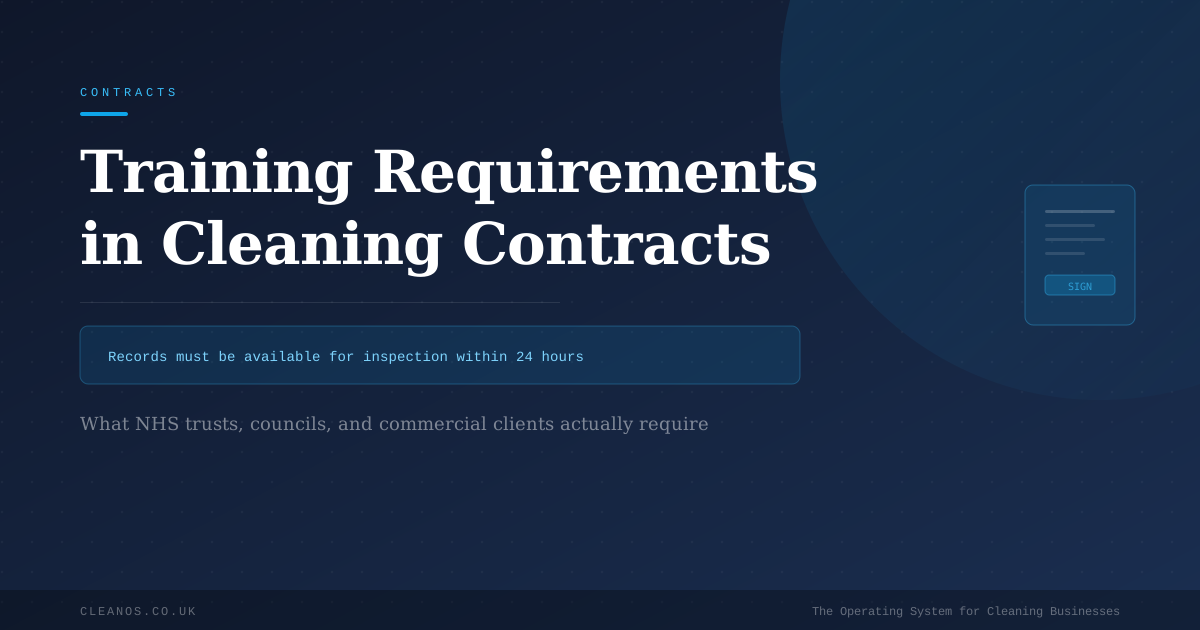
“Training records must be available for inspection within 24 hours of request.” This means a paper file in a drawer somewhere is not adequate. You need a system that lets you pull up training records quickly.
“New starters must complete induction training before working unsupervised on site.” This clause catches cleaning businesses who bring staff onto contracts before completing their onboarding. If a newly recruited operative is working your client’s site before you have induction records in place, you are in breach.
The core training areas you need to cover
For most commercial cleaning contracts, the training areas you need to document are:
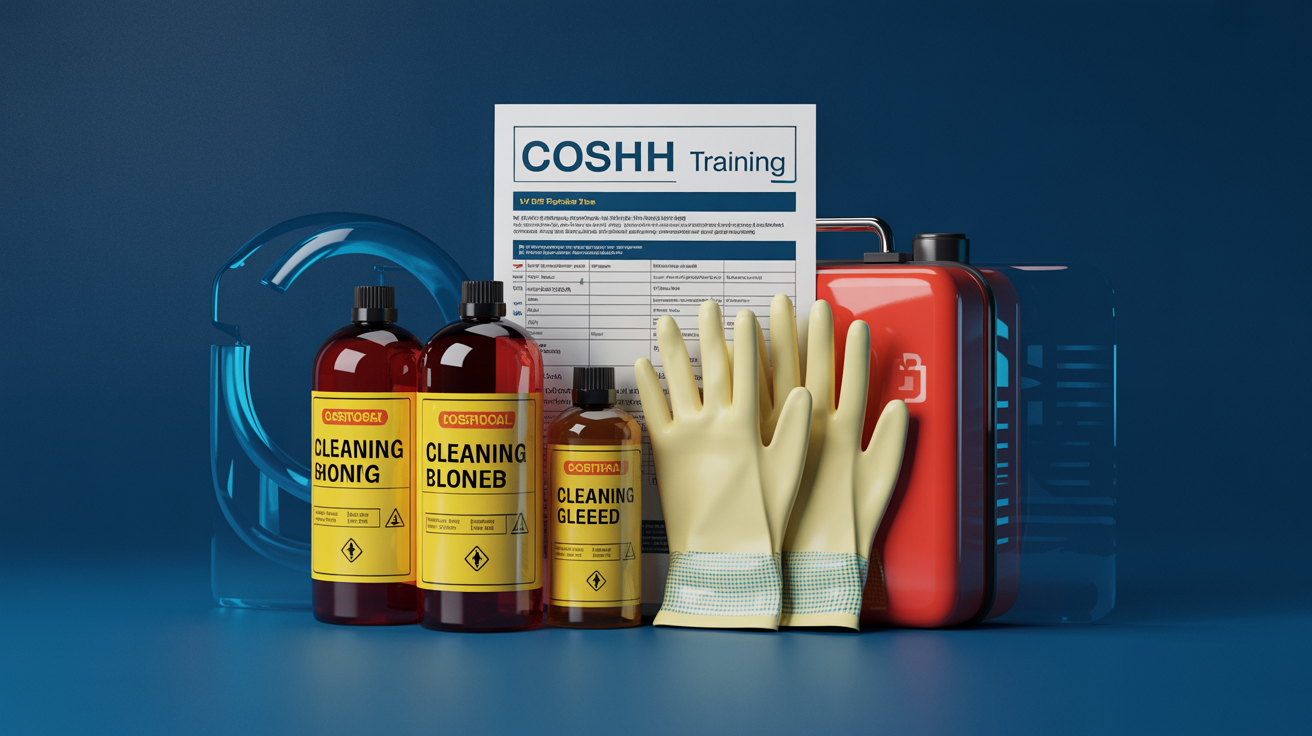
COSHH (Control of Substances Hazardous to Health Regulations 2002). Every operative who uses cleaning chemicals needs COSHH training. The certificate should confirm they can identify hazardous substances, read product labels, follow dilution instructions, use PPE appropriately, and respond correctly to a chemical incident. See the full COSHH training requirements guide for what must be covered.
Manual handling. Cleaning involves physical work: lifting equipment, moving furniture, carrying full buckets. A manual handling certificate confirms operatives have been trained in correct technique and understand how to reduce the risk of injury. The manual handling training guide covers the precise legal requirements.
Health and safety fundamentals. This covers slips and trips, fire safety, accident reporting, emergency procedures, and the general H&S awareness requirements under the Health and Safety at Work Act 1974.
PPE training. Confirmation that operatives have been trained in the use of personal protective equipment, including when to use it, how to use it, and how to report damaged or inadequate equipment.
Site induction. Many contracts require a record that each operative has received a site-specific induction before working on the client’s premises. This is separate from your general company induction and covers the specific hazards, procedures, and expectations of that site.
Additional requirements by contract type
Beyond the core set, specific contract types carry additional training requirements.
NHS and healthcare contracts. Operatives need clinical cleaning training covering infection prevention and control (IPC), decontamination versus disinfection, colour-coding in clinical environments, and the documentation requirements that healthcare clients must be able to show their own regulators. The NHS National Standards of Healthcare Cleanliness 2021 sets out these requirements in detail.
Schools and education. DBS checks are required for all operatives. Many schools also ask for safeguarding awareness training, even for cleaning staff.
Food production and hospitality. Sites with food handling or catering operations typically require food hygiene awareness and HACCP awareness training alongside standard cleaning certification.
Retail and commercial offices. These tend to be less prescriptive, but major clients increasingly ask for ISO 9001 or equivalent quality management evidence, which includes training records as part of the quality system.
Local authority contracts. Often come with a social value requirement, which can include commitments to staff training, apprenticeships, and professional development. Documented training programmes support your social value responses.
How to present training evidence in a PQQ
When a pre-qualification questionnaire asks about staff training, the weakest answers are vague commitments (“all staff receive appropriate training”) or reference to training that happened without documentation to back it up.
The strongest PQQ responses on training include:
A named training programme. Describe what it is called, how many modules it covers, what areas it addresses, and how certificates are issued.
Confirmation that records are maintained. State that you hold training records for every operative, that those records show completion date and certificate number, and that they are available for inspection.
Evidence of compliance monitoring. Describe how you track whether staff training is current, how you identify when refresher training is due, and how you handle new starters.
Reference to specific regulations. Mentioning COSHH, Manual Handling Regulations 1992, the Health and Safety at Work Act 1974, and PPE Regulations 2022 by name shows that your training programme is aligned with the actual legislative framework.
Common compliance failures to avoid
Undated certificates. A certificate with no date on it is nearly worthless in an audit. The date tells the client whether the training is current.
Generic provider certificates. A certificate that shows the training provider’s branding but not your company name creates the impression that you outsourced a one-off course years ago. Certificates that carry your company name are a stronger indicator of an embedded training culture — see white-label training platforms for how this works.
Missing coverage. Clients check that every operative on their contract has the required certificates, not just the supervisor or a sample of the team. If you have eight staff on a contract and six of them have current COSHH certificates, you have a compliance gap.
Training that precedes the most recent regulatory update. COSHH, PPE, and other regulations have been updated in recent years. Training completed before a major amendment may not cover current requirements.
No refresher process. Completing training once at induction and never revisiting it is not adequate for most commercial contracts.
Building a training programme that satisfies commercial requirements
The practical approach for a commercial cleaning business:
- Define the core training every operative must complete before working on any commercial site.
- Define the additional training required for specialist contracts (healthcare, education, food production).
- Choose a training delivery method that issues dated, named certificates automatically.
- Store records in a system that lets you retrieve them quickly and filter by site or contract.
- Set up a process to flag when training is approaching its renewal date.
- Reference your training programme explicitly in every PQQ and contract tender you submit.
Clients who ask about training are not trying to catch you out. They are looking for evidence that you run your business professionally and that the people working on their site are competent, informed, and documented. A training programme that meets those requirements is one of the most valuable assets your cleaning business can have.
CleanOS Training provides white-label, compliance-aligned training for commercial cleaning businesses. Seven courses covering every core training requirement in this article. Certificates issued automatically under your company name, records stored in a dashboard, available for client inspection within minutes. Book a free demo.
Ready to get your team trained?
Set up compliant, branded training for your cleaning staff in 48 hours. No trainer needed.
Book a Free Demo