Specialist Cleaning Training: What Courses Cover Biohazard and Clinical Environments
Biohazard and clinical cleaning require specific training that goes far beyond standard cleaning courses. This guide covers the legislation, PPE requirements, decontamination procedures, and qualifications that matter.
Why Specialist Cleaning Is a Different Category
General commercial cleaning covers a wide range of environments: offices, retail units, industrial facilities, schools, hospitality venues. The training required is thorough and substantive, but the risk profile is manageable with standard COSHH awareness, manual handling competence, and good working practice.
Specialist cleaning operates in a different risk category. The environments are more hazardous, the consequences of error are more severe, and the legal requirements are correspondingly more demanding. A cleaner working in a clinical ward, responding to a biohazard incident, or maintaining a food production facility is working with biological, chemical, or physical hazards that require specific knowledge, specific PPE, and specific procedures.
The gap between general cleaning competence and specialist cleaning competence is not a matter of experience. It is a matter of training. A cleaner with ten years in office environments is not automatically qualified to work in an NHS ward or attend a trauma scene. The training required is distinct, the qualifications are different, and the documentation requirements are more rigorous.
This guide covers what specialist cleaning training involves, what the legislation requires, and what your staff need to know to operate safely and compliantly in biohazard and clinical environments specifically.
Categories of Specialist Cleaning
Specialist cleaning divides broadly into five categories, each with its own risk profile, training requirements, and regulatory framework.
Biohazard and trauma cleaning covers the remediation of scenes involving blood, bodily fluids, sharps, decomposition, or other biological contamination. This includes crime scenes, trauma scenes, and situations involving Category B infectious substances. The primary risks are blood-borne pathogens and cross-contamination.
Clinical and healthcare cleaning covers patient-facing environments in NHS and private healthcare settings. Infection prevention is the dominant concern. The NHS National Standards of Cleanliness 2021 set out the technical standard for cleanliness in healthcare settings, and any contractor working in these environments is expected to demonstrate compliance with that standard.
Laboratory cleaning covers research and testing facilities, including those working with hazardous biological or chemical agents. The risk profile depends on the type of laboratory, which can range from low-risk analytical environments to high-containment settings governed by the Advisory Committee on Dangerous Pathogens (ACDP) guidance.
Food production cleaning covers food manufacturing and processing facilities where cleaning must meet food safety standards and where chemical residues present a contamination risk. The primary legislation is Regulation (EC) 852/2004 on food hygiene as retained in UK law.
Industrial cleaning covers heavy industry, petrochemicals, confined spaces, and environments involving hazardous materials such as asbestos, lead, or industrial solvents. Confined space cleaning in particular is governed by the Confined Spaces Regulations 1997 and requires specific training and competence.
This guide focuses on biohazard and clinical cleaning, as these are the categories most commonly sought by commercial cleaning businesses looking to diversify into higher-margin specialist contracts.
Biohazard Cleaning: The Risk Profile
Biohazard cleaning involves contact with or proximity to biological materials that carry infection risk. The specific hazards your staff need to be trained to manage include the following.
Blood-Borne Pathogens
Blood and other bodily fluids can carry blood-borne pathogens including hepatitis B, hepatitis C, and HIV. The risk of transmission through occupational exposure is real, though it varies by pathogen. Hepatitis B has the highest transmission risk from a single needlestick injury of the three commonly cited pathogens. Training must cover the nature of the risk, the routes of transmission, and the precautions that reduce exposure.
Bodily Fluids
Beyond blood, biohazard cleaning may involve contact with vomit, faeces, urine, saliva, or other bodily secretions. These can carry bacterial and viral pathogens including norovirus, C. difficile, and MRSA. Decontamination procedures must be appropriate for the specific pathogen risk present, and this requires staff to understand the difference between cleaning, disinfection, and sterilisation, and when each is required.
Sharps
Needlestick and sharps injuries are a serious occupational hazard in biohazard cleaning. Staff must know how to identify sharps hazards, how to manage them safely using appropriate sharps containers, and what to do in the event of a sharps injury, including the immediate first aid response and who to contact for post-exposure assessment.
Category 3 and 4 Biological Agents
The Control of Substances Hazardous to Health Regulations 2002 (COSHH) classify biological agents into four hazard groups based on their ability to cause human disease and the availability of effective treatment. Most biohazard cleaning situations involve Group 2 or Group 3 agents. Group 4 agents (such as those causing haemorrhagic fevers) require containment level 4 facilities and are not typically encountered in standard commercial biohazard cleaning. Staff working in environments where Group 3 agents are a risk, such as post-mortem facilities or high-containment healthcare settings, require specific additional training.
Legislation Governing Biohazard Cleaning
COSHH 2002
The Control of Substances Hazardous to Health Regulations 2002 form the primary legislative framework for biological hazard management in the workplace. Under COSHH, employers are required to:
- Assess the risks to health from biological agents in the workplace
- Prevent exposure where possible, or control it where prevention is not reasonably practicable
- Ensure control measures are properly used and maintained
- Provide information, instruction, and training to employees on the risks and the precautions to be taken
- Monitor exposure and health surveillance where appropriate
For biohazard cleaning, the risk assessment must identify the specific biological agents likely to be encountered, the routes of exposure, and the control measures in place. This assessment must be reviewed whenever there is reason to suspect it is no longer valid, and when significant changes occur to the work.
HSE Biological Hazards Guidance
The HSE publishes detailed guidance on working with biological agents, including specific guidance on biological agents in healthcare and guidance on managing blood-borne virus risk in the workplace. This guidance is not statutory, but it represents current best practice and will be referenced by enforcement bodies in the event of an incident or inspection.
The HSE’s guidance on categorisation of biological agents (aligned with the Advisory Committee on Dangerous Pathogens guidance) sets out which biological agents fall into each hazard group and what containment measures are required.
The Health and Safety at Work Act 1974
The general duty to ensure, so far as is reasonably practicable, the health, safety, and welfare of employees applies with particular force in high-hazard environments. For biohazard cleaning specifically, this means you cannot send an untrained member of staff to a trauma scene on the basis that you planned to train them later.
PPE Requirements for Biohazard Cleaning
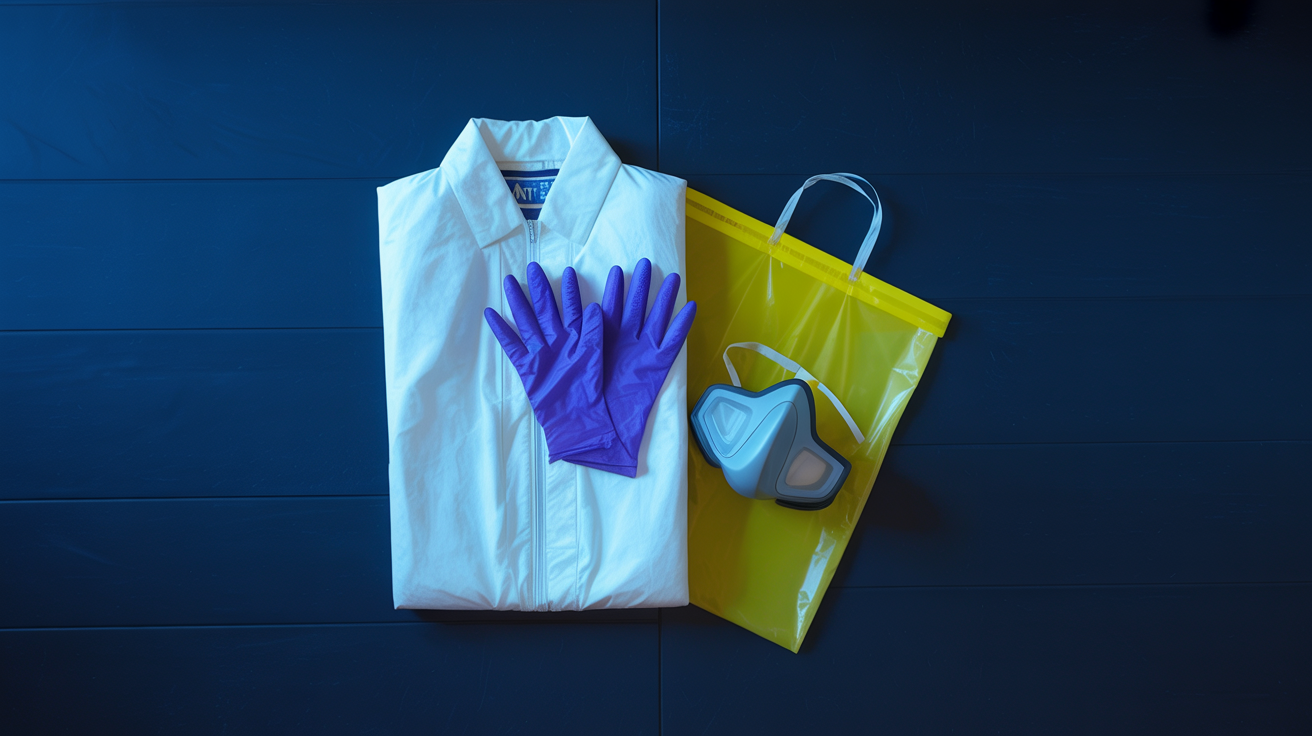
PPE in biohazard cleaning is not optional. The Personal Protective Equipment at Work Regulations 1992 (as amended 2022) require employers to provide appropriate PPE where risk cannot be adequately controlled by other means, and to ensure that employees are trained in its use.
For biohazard cleaning, the minimum PPE standard for most scenarios is:
| Item | Specification | Notes |
|---|---|---|
| Coverall | Type 5/6 disposable (minimum) | Full body protection. Type 5 for dry particles, Type 6 for light liquid splash. Higher hazard scenes may require Type 4 or 3. |
| Respiratory protection | FFP3 half-mask or full-face respirator | FFP3 is the minimum for biological hazard environments. Standard dust masks (FFP1/FFP2) are not adequate. |
| Gloves | Double-gloved: nitrile inner, heavier outer | Inner glove stays on throughout. Outer glove changed between zones or when contaminated. |
| Eye/face protection | Goggles or full-face shield | Goggles where splash risk is possible. Full-face shield where fogging or aerosol generation is involved. |
| Boot covers or dedicated footwear | Chemical-resistant covers | Prevent cross-contamination between zones and protect footwear from saturation. |
All PPE must be:
- Appropriate for the specific hazard (not just any PPE)
- Fitted correctly, with fitting demonstrated as part of training
- Donned and doffed in the correct order to prevent self-contamination
- Disposed of correctly as clinical or hazardous waste
The doffing (removal) sequence is where most contamination incidents occur. Staff must be trained and regularly drilled in the correct procedure: remove outer gloves first, then boot covers, then coverall (rolling outward, not pulling off), then eye protection, then inner gloves, then wash hands. Getting this sequence wrong defeats the purpose of wearing the PPE in the first place.
Decontamination Procedures for Biohazard Cleaning
Decontamination in a biohazard context means achieving a defined reduction in biological contamination on a surface or area. The specific procedure depends on the biological agent, the nature of the contamination, and the surface being decontaminated.
Disinfectants
Chlorine-based disinfectants (hypochlorite solutions) are the standard choice for biohazard cleaning because of their broad-spectrum efficacy against bacteria, viruses, and fungi. The concentration required depends on the organism and the level of organic matter present. Staff must understand that bleach does not work effectively in the presence of heavy organic soil, which is why cleaning (removing gross contamination) must precede disinfection.
Other agents used in specialist situations include quaternary ammonium compounds (QACs), hydrogen peroxide vapour, and peracetic acid. The selection of the appropriate agent is part of the risk assessment and method statement for each job.
Fogging and Misting
Hydrogen peroxide fogging and antimicrobial misting are used for area decontamination where manual cleaning is insufficient or impractical. These processes require specific training in equipment operation, correct concentration settings, and safe re-entry times. Staff must understand that fogging supplements manual cleaning; it does not replace it.
Waste Disposal
Waste generated during biohazard cleaning is classified as hazardous waste and must be disposed of through a licensed clinical or hazardous waste contractor. Category B infectious substance waste is transported in UN3291-compliant packaging. Waste transfer notes must be retained for a minimum of three years. Your staff need to understand waste classification, segregation into the correct receptacles, labelling, and the waste transfer documentation process.
Want your specialist cleaning team trained to the right standard, with digital records and refresher reminders built in? Book a free demo of CleanOS Training and see how the platform handles specialist compliance.
Clinical Environment Cleaning: The NHS Standard
If your business is pursuing NHS or healthcare contracts, the NHS National Standards of Cleanliness 2021 (NSC 2021) is the document you need to know. It sets out the technical framework for cleanliness in NHS provider organisations and is used as a benchmark by commissioners and auditors.
Colour-Coded Equipment
The NHS colour-coding system for cleaning equipment is designed to prevent cross-contamination between different zones and functional areas. The standard colours are:
| Colour | Zone |
|---|---|
| Red | Washrooms, toilets, bathrooms |
| Yellow | Isolation areas and infectious areas |
| Blue | General areas including wards, offices, corridors |
| Green | Catering and domestic food preparation areas |
Your staff must not take red-zone equipment into a blue-zone area, regardless of how recently it was cleaned. The colour-coding is a procedural control, not just a preference. Auditors check this, and clients take it seriously.
Zone Cleaning
Zone cleaning means working in a defined direction through a clinical area, typically from clean to dirty zones, to avoid transferring contamination back to areas already cleaned. In a ward environment, this typically means starting at the furthest point from the entrance and working back toward the exit, cleaning around beds in a consistent pattern.
Contact Times for Disinfectants
One of the most common training failures in clinical cleaning is the misapplication of disinfectants, specifically, not allowing them to remain wet on the surface for the required contact time. Contact time is the period the disinfectant must remain on the surface to achieve the stated log reduction in microorganisms. If a surface is wiped dry before the contact time has elapsed, the disinfection has not been effective.
Contact times vary by product and by target organism. Staff must be trained on the specific contact times for each product in their kit and understand that “it looks clean” is not the same as “it has been disinfected.”
Frequency Standards
NSC 2021 specifies different cleaning frequency requirements for different functional areas and risk categories. High-risk clinical areas such as intensive care units and operating theatres require more frequent cleaning and higher levels of scrutiny than low-risk areas such as offices and meeting rooms. Your cleaning specification must reflect these requirements, and your staff must understand why different areas have different standards.
Infection Prevention: Standard and Transmission-Based Precautions
Clinical cleaning staff need to understand the principles of infection prevention, even if they are not clinical practitioners. This is because their work directly affects the infection risk in patient environments.
Standard precautions apply to every patient and every environment, regardless of whether a known infection is present. They include hand hygiene, appropriate use of PPE, safe handling of sharps, and correct disposal of clinical waste. Staff in clinical environments must apply these precautions as routine practice, not only when a patient is known to be infected.
Transmission-based precautions apply in addition to standard precautions when a patient is known or suspected to be infected with a pathogen that requires additional control measures. These precautions divide into:
- Contact precautions for organisms spread by direct or indirect contact (MRSA, C. difficile, norovirus)
- Droplet precautions for organisms spread by respiratory droplets (flu, meningococcal disease)
- Airborne precautions for organisms spread by airborne particles (tuberculosis, measles)
Cleaning staff working on isolation rooms or in areas under transmission-based precautions need to know what the precautions mean in practice for their cleaning procedure, what PPE is required, how to enter and exit the area safely, and how to decontaminate their equipment afterward.
Recognised Training Providers and Qualifications
BICS (British Institute of Cleaning Science)
BICS is the leading professional body for the cleaning industry in the UK. Their qualifications are widely recognised by clients and procurement teams. For specialist cleaning, the most relevant BICS qualifications include:
- BICS Level 2 Award in Cleaning Science — foundation level, suitable for general and specialist environments
- BICS cleaning technician awards covering specific specialist areas
- BICS Infection Control in Cleaning — relevant for healthcare and clinical environments
BICS qualifications are verifiable and add weight to your tender submissions and pre-qualification questionnaires.
IICRC (Institute of Inspection, Cleaning and Restoration Certification)
The IICRC is the primary certification body for trauma scene and biohazard cleaning. Their Trauma and Crime Scene Technician (TCST) course is the recognised standard for biohazard remediation work. It covers blood-borne pathogens, PPE protocols, decontamination procedures, waste disposal, and documentation requirements.
While IICRC is a US-based body, its certifications are recognised internationally and are frequently referenced in specialist cleaning tenders in the UK. For a business that wants to position itself credibly in the biohazard remediation market, IICRC TCST-certified staff is a meaningful differentiator.
In-House and Platform-Based Training
Not every training element requires an externally awarded qualification. COSHH awareness, manual handling, PPE use, colour-coding, and infection prevention basics can all be delivered via structured in-house training, provided the training is documented, consistent, and appropriate to the role.
For refresher training and ongoing competence management, digital training platforms allow staff to complete modules and generate records without requiring a trainer to be physically present. This is particularly useful for refresher cycles where the content is established and the requirement is compliance documentation rather than new skills acquisition.
What a Biohazard Cleaning Course Should Cover
A complete biohazard cleaning course should address the following areas. If a course you are evaluating does not cover these elements, it is not fit for purpose.
- Biological hazard classification (COSHH Groups 1-4, what each means in practice)
- Blood-borne pathogen risk: hepatitis B, hepatitis C, HIV, transmission routes, relative risk
- PPE selection, fitting, donning and doffing sequence, disposal
- Disinfectant selection and application: chlorine-based products, contact times, dilution ratios
- Decontamination methodology: cleaning before disinfection, zoning, preventing cross-contamination
- Sharps management: identification, safe handling, sharps injury response
- Waste classification and disposal: Category B infectious waste, UN3291 packaging, waste transfer notes
- Post-incident procedures: incident reporting, exposure reporting, post-exposure prophylaxis access
- Documentation: risk assessment, method statement, job record, waste transfer note
What a Clinical Cleaning Course Should Cover
A clinical cleaning course targeted at healthcare environments should cover:
- NHS NSC 2021: the standard, how it is audited, what it means for cleaning practice
- Colour-coded equipment protocol: which colour for which zone, what happens if it is breached
- Zone cleaning technique: clean to dirty, bed spacing, high-touch surface prioritisation
- Decontamination basics: difference between cleaning, disinfection, and sterilisation
- Contact times: how to apply disinfectant correctly, why timing matters
- Standard precautions: hand hygiene, PPE in clinical areas, waste management
- Transmission-based precautions: contact, droplet, airborne, what each means for the cleaner
- Isolation room procedure: how to enter and exit an isolation room, equipment decontamination
- Infection prevention in practice: hand hygiene compliance, uniform/workwear standards, equipment storage
Refresher Frequency and Ongoing Competence
Biohazard Training
Biohazard training should be refreshed annually as a minimum. The annual cycle allows you to incorporate any changes to HSE guidance, COSHH assessments, or waste disposal regulations, and to ensure that staff who may not have attended a biohazard scene for some months are kept current.
In addition to the annual refresh, refresher training should be triggered by:
- Any significant change to the products, procedures, or equipment used
- Any incident, near miss, or enforcement action
- A period of extended leave or absence
Clinical Cleaning Training
NHS NSC 2021 is reviewed periodically, and guidance from UKHSA (formerly Public Health England) on specific organisms and precautions is updated when the evidence base changes. Clinical cleaning staff should receive refresher training at least annually and whenever significant guidance changes occur.
Documentation Requirements
In specialist cleaning, documentation is not administrative overhead. It is part of the service and part of your liability protection.
For every biohazard job, you should retain:
- Risk assessment and method statement, specific to that job
- Pre-job briefing record confirming which staff attended and what was covered
- PPE issuance records for the job
- Chemical safety data sheets for every product used
- Job completion record, signed by the operative and, where applicable, the client
- Waste transfer notes for all hazardous waste removed from site
- Incident or near-miss reports if any occurred
For ongoing clinical cleaning contracts:
- Training records for every cleaner assigned to the contract, including expiry dates
- Site-specific COSHH assessments
- RAMS (Risk Assessment and Method Statement) for the contract
- Audit and inspection records
- Any non-conformance reports and the corrective actions taken
These records are what procurement teams and NHS auditors ask for when they assess your capability. They are also what protects you in the event of a complaint, incident, or regulatory investigation.
General vs. Specialist Cleaning Training: A Comparison
| Area | General Cleaning Training | Specialist (Biohazard / Clinical) Training |
|---|---|---|
| Primary legislation | COSHH 2002, H&S at Work Act 1974 | COSHH 2002 (biological agents), HSE biological hazard guidance, NHS NSC 2021 |
| PPE level | Basic: gloves, apron | Full: coveralls, FFP3 respirator, double gloves, eye protection |
| Chemical knowledge | Product awareness, dilution rates | Disinfectant selection by pathogen, contact times, fogging agents |
| Waste disposal | General waste, recyclables | Category B infectious waste, UN3291 packaging, waste transfer notes |
| Training qualification | BICS Level 2 or equivalent | BICS infection control, IICRC TCST (biohazard); NHS NSC 2021 competency (clinical) |
| Refresher frequency | Every 2-3 years typical | Annually as minimum |
| Documentation requirements | Training records, COSHH assessments | Training records, RAMS per job, waste transfer notes, job completion certificates |
| Audit exposure | Internal quality audits | NHS cleanliness audits, HSE inspections, client pre-qualification questionnaires |
| Risk of getting it wrong | Minor: quality complaints, rework | Serious: cross-infection, HSE enforcement, personal injury claims, contract loss |
Winning Healthcare Contracts Through Training Evidence
One of the practical reasons to invest in certified specialist training is the impact on your ability to win contracts. NHS and healthcare procurement teams, as well as commercial clients in the care sector, assess cleaning contractors through pre-qualification questionnaires (PQQs) that typically include requirements such as:
- Confirmation that staff working on clinical premises hold relevant training qualifications
- Evidence of COSHH risk assessments for all products used on healthcare sites
- Method statements for infection prevention in patient environments
- Evidence of training record management, including expiry date tracking
- Named responsible persons for health and safety
If you cannot produce training certificates, training records with expiry dates, and method statements tailored to clinical environments, your tender will fail at the pre-qualification stage regardless of your pricing. The training is not just about safety. It is the evidence that procurement teams need to see before they will award you the contract.
Building a Specialist Cleaning Training Programme
A credible specialist training programme for biohazard and clinical cleaning does not require every member of your team to hold every qualification. What it requires is:
- A clear identification of which roles require specialist training, based on the sites and contract types you work on
- A bank of core training modules that every specialist operative completes, covering the basics of biological hazard, PPE, and decontamination
- Role-specific qualifications (IICRC TCST for biohazard operatives; BICS infection control for clinical operatives) for those who will work in those environments regularly
- A training matrix that shows who is trained, to what level, and when their qualifications expire
- An annual refresher cycle with documented completion records
- Site-specific inductions and RAMS for each contract, updated when the scope of work or the site conditions change
The record-keeping is what separates a credible specialist operation from one that claims specialist capability it cannot evidence. When a client, auditor, or enforcement officer asks to see training records, you need to produce complete, current, and signed documentation within minutes, not days.
Building out your specialist cleaning capability and need a platform to manage training records, expiry dates, and compliance documentation across your whole team? Book a free demo of CleanOS Training and see how it works for specialist contractors.
Ready to get your team trained?
Set up compliant, branded training for your cleaning staff in 48 hours. No trainer needed.
Book a Free Demo