What Training Does a New Cleaning Employee Need Before Starting Work?
A practical guide for UK cleaning business owners on the legal training requirements for new starters, covering day-one inductions, COSHH, manual handling, site-specific training, and how to document it all correctly.
Sending a new cleaner to a site before they have been properly trained is not just a management shortcut. It is a breach of your legal duties as an employer, and if something goes wrong, you will bear the consequences. The Health and Safety at Work etc. Act 1974 and the regulations that sit beneath it are clear: training comes before work, not alongside it or after it.
This guide covers exactly what training a new cleaning employee must receive before they start work, what the law requires, how to structure a practical first-week induction, and how to document it in a way that protects both the worker and your business.
Your Legal Obligation to Train Before Work Begins
Section 2(2)(c) of the Health and Safety at Work etc. Act 1974 requires every employer to provide, so far as is reasonably practicable, “such information, instruction, training and supervision as is necessary to ensure, so far as is reasonably practicable, the health and safety at work of his employees.” This duty applies from the moment a worker enters your employment. It does not have a grace period.
The Management of Health and Safety at Work Regulations 1999 (Regulation 13) reinforce this. Employers must ensure employees are provided with adequate health and safety training when they are recruited and when they are exposed to new or increased risks. The word “when” in that Regulation means before the exposure, not during it.
For young workers (those under 18), Regulation 19 of the Management Regulations requires a specific risk assessment before they start work, taking into account their inexperience, lack of awareness of risks, and immaturity.
The HSE’s guidance document “Training: A Brief Guide” (INDG345) states: “Think about what employees need to know before they start work. New employees need basic safety information from the start.” In cleaning, that basic safety information is substantial, because the risks are real and present from the first shift.
What Must Be Covered in Day-One Induction
Before a new cleaner sets foot on a client site, they must have received induction training covering the following.
Health and Safety Policy
You must inform every new employee of your company’s health and safety policy statement. Under s.2(3) of the 1974 Act, employers with five or more employees must have a written policy and bring it to the attention of all employees. The new starter must be told who is responsible for health and safety in your business and how concerns should be raised.
Emergency Procedures
Before they arrive at any site, new starters must know the emergency procedures. On day one in your business, this means your general emergency protocol. On their first visit to a specific site, it means the site-specific procedures. This includes:
- How to raise the alarm in the event of fire or serious injury
- The location of fire exits and assembly points (site-specific)
- Who to contact in an emergency (your supervisor or duty manager)
- How to call for first aid
Do not assume they know these things. You must tell them, confirm they understand, and record it.
COSHH Basics
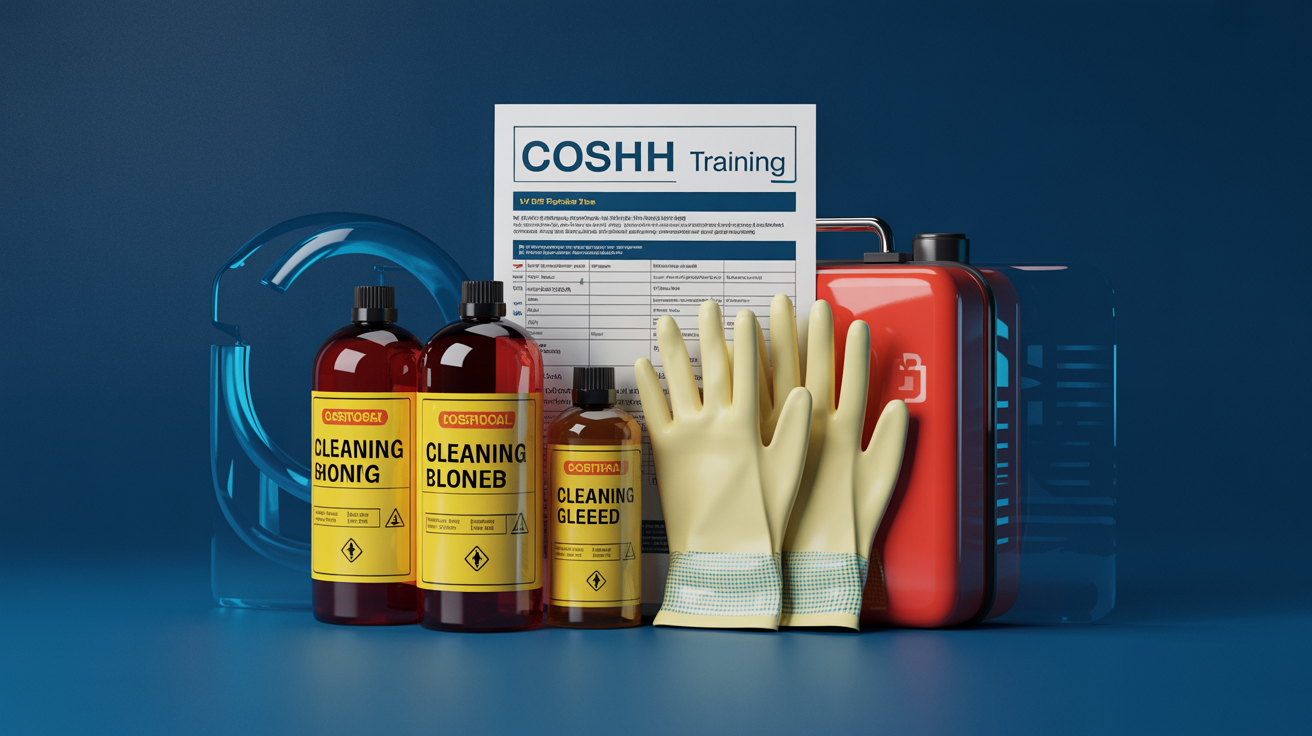
No new cleaner should be allowed to touch a cleaning chemical before receiving at minimum an introduction to COSHH. This does not need to be a full two-hour session on day one, but it must cover:
- Why chemicals used in cleaning can cause harm
- How to read a product label and identify hazard symbols
- The importance of never mixing chemicals
- Where to find the Safety Data Sheet for any product
- What PPE is required for each product they will use and how to use it
Full COSHH training to the standard required by the Control of Substances Hazardous to Health Regulations 2002 must be completed before they handle any hazardous substance, even if that means they cannot start cleaning tasks on day one.
PPE Issue and Fitting
New starters must be issued with their PPE before starting work. Under the Personal Protective Equipment at Work Regulations 2022, PPE must be suitable for the risk, properly fitted to the individual, and accompanied by adequate instruction and training. Handing someone a pair of gloves and hoping for the best does not meet that standard. Show them which gloves to use for which tasks, how to put them on correctly, and how to remove them without contaminating their hands.
Reporting Procedures
Every new starter needs to know how to report an accident, incident, or near-miss. They should understand that near-miss reporting is expected, not penalised, and that they know who to tell and how to record it.
COSHH Training Before Handling Any Chemicals
This point deserves separate emphasis because it is the most commonly skipped step in cleaning business inductions.
The COSHH Regulations 2002 require training before a worker handles a hazardous substance. A worker who arrives on site and picks up a multi-surface spray before their COSHH training is complete represents a compliance failure. It is also a genuine safety risk, as outlined in the full COSHH training guide for cleaning businesses.
Your day-one COSHH induction must cover, at minimum:
- The specific products used in your standard cleaning kit
- The hazard classifications of those products (corrosive, irritant, sensitiser)
- The dilution ratios and safe handling practices for each
- The incompatibility risks, particularly bleach and acid-based products
- PPE requirements for each product
- What to do if there is a spill or accidental exposure
Product-specific training must be completed before the worker handles that product. If a new starter is moved onto a specialist contract (deep clean, kitchen, healthcare) that involves additional chemicals, they need further training before that contract begins.
Ready to build a structured onboarding programme for your cleaning team? Book a free demo of CleanOS Training and see how you can deliver, track, and document new starter training from day one.
Manual Handling Training Before Physical Tasks
The Manual Handling Operations Regulations 1992 require employers to assess the risk of injury from manual handling tasks and take steps to reduce that risk. In cleaning, manual handling tasks include:
- Carrying heavy buckets of water or chemical solution
- Moving commercial cleaning machines (floor polishers, scrubber dryers)
- Lifting and carrying stock and equipment between floors or in and out of vehicles
- Operating pressure washers and backpack vacuums
New starters must receive manual handling training before undertaking these tasks. Training should cover the basic principles of safe lifting technique, how to assess a load before lifting, when to ask for help or use mechanical assistance, and how to report musculoskeletal discomfort early.
Manual handling injuries are one of the most common causes of absence and employers’ liability claims in the service sector. Training records are frequently requested during insurance claims investigations. If you cannot show that a worker received manual handling training before injury, your position is significantly weakened.
Site-Specific Induction Requirements
General company induction is not a substitute for site-specific induction. Every site your cleaners work on will have different:
- Emergency exit locations and evacuation procedures
- Hazards specific to that building (plant rooms, loading bays, fragile floors)
- Access and security requirements
- Permitted and restricted areas
- Client-specific protocols (noise restrictions, waste disposal, chemical storage rules)
Before a new cleaner works alone on a site, they must have received a site induction from either you, a supervisor, or a responsible person at the client site. This induction must be documented. Keep a record of the date, who conducted the induction, and what was covered. Many commercial clients have their own induction requirements, and you should obtain copies of those records.
Lone Working Considerations
In cleaning, lone working is common. Early morning office cleans, late-night retail cleans, and weekend industrial cleans are often carried out by one worker without on-site supervision. New starters should not be placed in lone working situations before their induction is complete and before they have been assessed as competent to work unsupervised.
For lone workers, additional training should cover:
- Your lone working procedure and check-in protocol
- What to do if they feel unsafe or encounter an unexpected hazard
- How to contact their supervisor or emergency services
- Any specific risks associated with the site (working at height, biohazards, plant equipment)
The Management of Health and Safety at Work Regulations 1999 require employers to assess the specific risks of lone working and take appropriate measures. For new starters, this assessment should flag them as higher risk until they have completed induction and demonstrated competence.
Probationary Period Training Structure
A structured training plan for the first week and first month is both a legal safeguard and a practical tool for reducing errors and turnover. New starters who are well-trained in the first month make fewer mistakes, cause fewer incidents, and are more likely to stay.
Sample 5-Day New Starter Training Schedule
| Day | Training Content | Format |
|---|---|---|
| Day 1 | Company H&S policy. Emergency procedures (general). COSHH introduction. PPE issue and fitting. Manual handling basics. Reporting procedures. | Face-to-face with supervisor |
| Day 2 | Full COSHH training for standard chemical set. SDS walkthrough for each product. Incompatibility risks. Correct dilution and storage. | Formal training session, signed off |
| Day 3 | Cleaning SOPs for standard office or commercial clean. Quality standards and inspection criteria. Client communication protocols. | Observed practice with supervisor |
| Day 4 | Site-specific induction for first contracted site. Emergency exits, hazards, restrictions, access, waste disposal. | On-site with supervisor or client contact |
| Day 5 | Manual handling assessed practice. Equipment operation (vacuum, mop system, any machinery relevant to role). Lone working procedures if applicable. | Observed with sign-off |
By the end of the first week, the new starter should be able to work under supervision competently and safely. They should not work unsupervised until the end of week one at the earliest, and only after a supervisor has assessed their competency on the core tasks.
First month continuation:
- Week 2 to 4: Supervised on-site work with periodic checks
- End of month 1: Formal review meeting, training matrix updated, any gaps addressed
- Month 2 onward: Specialist training if applicable (deep clean, TUPE transition, healthcare protocols)
The Risk of Skipping Training
Some cleaning businesses treat induction training as a delay to getting work done. The consequences of that approach can be severe.
Training Done vs. Training Skipped: What Is at Stake
| Scenario | Training Completed | Training Skipped |
|---|---|---|
| Chemical exposure incident | Demonstrable compliance, defence in claims | Employer liable, insurance may not cover |
| HSE inspection | Training records provided, no enforcement action | Improvement notice, possible prosecution |
| Worker injury claim | Training record supports your defence | No record, indefensible position |
| Contract audit by client | Audit passed, training evidence provided | Contract at risk or lost immediately |
| Worker mixes incompatible chemicals | Training on incompatibility was given and recorded | Negligence exposure, potential prosecution |
| New starter makes costly error | Reasonable steps taken, risk managed | Systemic failure, damages on the table |
The financial and legal consequences of an untrained worker causing an incident are not proportionate to the time saved by skipping induction. A standard company induction and COSHH training session takes half a day. A single employers’ liability claim, HSE prosecution, or contract termination can cost tens of thousands of pounds.
How to Document New Starter Training Correctly
Documentation is your evidence of compliance. Without it, you cannot prove training took place, even if it did.
Training matrix. Maintain a spreadsheet or digital record with one row per employee and one column per training module. Each cell should contain the completion date and, ideally, the name of the trainer. Modules should include: H&S induction, COSHH, manual handling, fire safety, PPE, site-specific induction (per site), and any specialist modules. Flag modules that are due for renewal.
Sign-off sheets. After every training session, the worker should sign and date a record confirming they attended and understood the content. Keep these records on file. They are your primary documentary defence if a claim or enforcement investigation arises.
Site induction records. Keep a separate record for each site, showing which workers have been inducted on that site and when. Where the client holds an induction record on their own system, obtain a copy for your files.
Probationary review notes. At the end of the first month, conduct a brief documented review. Record what training has been completed, the worker’s assessed competency, and any outstanding modules. Sign and date it.
Retention period. Retain training records for the duration of employment and for at least three years after a worker leaves. For workers who were exposed to substances with long-term health effects (under COSHH health surveillance), records must be retained for up to 40 years.
The Legal Minimum vs. The Professional Standard
To summarise: the law requires you to train before work begins, and to document that training. The minimum training required before a new cleaning operative starts work is:
- Health and safety induction (H&S policy, emergency procedures, reporting)
- COSHH training specific to the products they will use
- Manual handling training before any physical tasks
- PPE instruction and fitting
- Site-specific induction before unsupervised work on any client site
Meeting the legal minimum protects you from enforcement action. Meeting the professional standard, which means structured training, consistent documentation, and a clear first-month programme, protects your contracts, your reputation, and your staff.
Cleaning businesses that take training seriously win tenders. Commercial clients and facilities managers ask for evidence of staff training as a standard part of procurement and contract review. A well-documented training programme is a commercial asset, not just a compliance obligation.
Build an onboarding programme your clients can see. Book a free demo of CleanOS Training and find out how UK cleaning businesses use CleanOS to deliver compliant new starter training, generate audit-ready records, and cut onboarding time in half.
Statutory References
- Health and Safety at Work etc. Act 1974 — s.2(2)(c) and s.2(3)
- Management of Health and Safety at Work Regulations 1999 — Regulations 13 and 19
- Control of Substances Hazardous to Health Regulations 2002
- Manual Handling Operations Regulations 1992
- Personal Protective Equipment at Work Regulations 2022
- HSE guidance: INDG345 “Training: A Brief Guide”
- HSE guidance: “New and Young Workers” — hse.gov.uk/youngpeople
Ready to get your team trained?
Set up compliant, branded training for your cleaning staff in 48 hours. No trainer needed.
Book a Free Demo